ANGМU TE: NUNGUA’S HERITAGE, THE GADANGME IDENTITY AND A WORLD OF POSSIBILITIES

As Nungua prepares to celebrate the Dzenten Festival on 1st November 2026 the world has an opportunity to rediscover a remarkable chapter of GaDangme heritage.
Some places are more than geographical locations; they are repositories of history, identity, spirituality and collective memory. Angmu Te, popularly known as the Meridian Rock, represents such a heritage for Nungua and the wider GaDangme State.
The significance of Angmu Te extends beyond its physical presence. The Greenwich Prime Meridian, the internationally recognised reference line for zero degrees longitude, passes through Ghana’s coastal area around Tema. This geographical distinction offers Ghana a unique opportunity to connect its cultural heritage with a global landmark associated with navigation, cartography, astronomy and timekeeping.
For Nungua, the story is even more profound. Angmu Te is associated with ancestral traditions and the spiritual heritage of the land. Preserving its memory is therefore not merely about promoting a tourist attraction; it is about safeguarding a cultural inheritance that deserves to be understood, documented and transmitted to future generations.
A DAUGHTER OF THE LAND, A VISION FOR HER COMMUNITY
Professor Goski Alabi, Vice-Chancellor of Accra Metropolitan University, deserves recognition for championing an initiative that seeks to bring renewed attention to this important heritage.
As a daughter of Nungua, her involvement presents an opportunity to connect academic research, cultural preservation, institutional collaboration and community development in pursuit of a shared goal.
Working in collaboration with the Office of the Gborbu Wulomo-Shitse, the spiritual authority and custodian of sacred traditions within the GaDangme State, the initiative seeks to give Angmu Te greater visibility and establish a stronger foundation for its recognition as a heritage site of international interest.
The question, therefore, is not why a daughter of the land should seek to bring attention to her community’s heritage, but how Nungua can collectively support a well-researched initiative with the potential to benefit generations yet unborn.
The proposed festival is an opportunity to transform cultural memory into a platform for education, tourism, research and sustainable development.
THE SPIRITUAL DIMENSION: DJENTEN NI SHWAMOR
Beyond its geographical importance, Angmu Te holds a place within Nungua’s traditional and spiritual heritage.
The observance is connected to the pre-festival rites known as Dzenten ni Shwamor, reflecting the cultural and spiritual traditions surrounding the site.
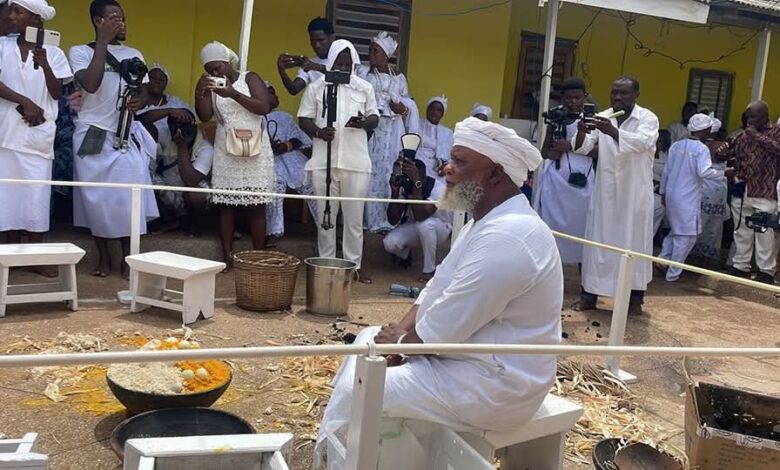
Year after year, the traditional authority of the Gborbu Wulomo-Shitse oversees sacred observances associated with the land. Among these is the preparation of Atobi, sacred corn sprinkled in accordance with tradition as part of the rites and their spiritual significance.
These practices are important expressions of the relationship between the people, their ancestors, their environment and their understanding of the spiritual world.
Wor Lumor Konor Nuumo Borketey Laweh Tsuru, the Gborbu Wulomo-Shitse and Spiritual Overlord of the GaDangme State, occupies a significant traditional role in the preservation and observance of these sacred customs.
His involvement reflects the importance of ensuring that heritage promotion proceeds with due regard for the traditional custodians, established rites and cultural protocols that give Angmu Te its deeper meaning.
The objective is to bring the spiritual, historical, academic and tourism dimensions together in a manner that respects tradition while opening new possibilities for the future.
WHY THE WORLD SHOULD PAY ATTENTION
The ambition to secure international heritage recognition for Angmu Te deserves serious consideration. Although UNESCO World Heritage inscription is a process requiring rigorous assessment against established criteria, authenticity, protection and management requirements, the pursuit itself can encourage valuable research, conservation and public engagement.
A successful heritage-development programme could create several opportunities for Nungua and Ghana, including:
– Tourism and international visibility: Attracting visitors, researchers, historians, cultural enthusiasts and international heritage organisations.
– Employment and local enterprise: Creating opportunities for tour guides, hospitality businesses, artisans, food vendors, transport operators and other local entrepreneurs.
– Youth education and cultural continuity: Helping young people understand GaDangme history, traditional institutions and ancestral heritage.
– Research and documentation: Encouraging universities, historians, archaeologists and cultural experts to investigate, document and preserve the story of Angmu Te.
– Investment and community development: Creating opportunities for partnerships, cultural infrastructure and responsible tourism.
– National and continental pride: Positioning Ghana and Africa more prominently in conversations about the preservation of indigenous heritage and the importance of African cultural knowledge.
These possibilities are worth exploring through careful planning, community participation and sustained collaboration.
A FESTIVAL BUILT ON PREPARATION AND COLLABORATION
The Dzenten Festival is not simply an occasion to gather, celebrate and disperse. It is an opportunity to give renewed life to a heritage story that deserves wider recognition.
Behind an initiative of this nature are research, consultations, institutional engagement, cultural preparation and the work required to bring diverse stakeholders around a common purpose.
The collaboration between Accra Metropolitan University and the Office of the Gborbu Wulomo-Shitse provides a platform for combining academic expertise with traditional knowledge. Such partnerships can help ensure that cultural promotion is informed by research, respectful of customary authority and beneficial to the community.
Nungua’s traditional institutions, including Oboade Notse King Odai Fio Welentsi III, the Nungua Mantse and President of the Greater Accra Regional House of Chiefs, alongside other traditional authorities and community stakeholders, have important roles to play in the broader conversation about preserving and promoting the area’s heritage.
The wider GaDangme traditional leadership also has an opportunity to support an initiative that can bring attention to the history, identity and cultural contributions of our people.
The participation and engagement of stakeholders can strengthen the festival’s impact and help ensure that its benefits extend beyond a single day.
THE GBORBU WULOMO-SHITSE: CUSTODIANSHIP AND COMMUNITY PROGRESS
Wor Lumor Konor Nuumo Borketey Laweh Tsuru, the Gborbu Wulomo-Shitse, represents a traditional institution whose responsibilities include the preservation of sacred customs and the protection of the spiritual heritage entrusted to it.
His involvement in this initiative should be understood within that context: the advancement of heritage preservation, the recognition of traditional knowledge and the pursuit of opportunities that can benefit Nungua and the GaDangme State.
Tradition and development need not stand in opposition. When handled with mutual respect, they can reinforce each other, ensuring that progress does not erase identity and that heritage remains relevant to contemporary society.
This is the opportunity before Nungua: to demonstrate that its ancestral heritage can be preserved with dignity while serving as a foundation for education, tourism, cultural exchange and economic opportunity.
1ST NOVEMBER 2026: A DATE TO ANTICIPATE
If you have not experienced the excitement of seeing your community’s heritage receive wider attention, 1st November 2026 presents a reason to look forward with anticipation.
The Dzenten Festival offers an opportunity to bring together traditional leaders, academics, cultural practitioners, dignitaries, residents and visitors from near and far in celebration of a heritage that belongs to Nungua and forms part of Ghana’s broader cultural story.
Imagine the possibilities when the history of Angmu Te is researched more deeply, its traditions are documented, its story is shared with the world and younger generations are encouraged to take pride in their inheritance.
That is the greater promise of this initiative.
The objective is not merely to organise a festival; it is to build a lasting platform for heritage recognition, cultural education and community advancement.
Let us therefore approach this historic undertaking with open minds, a shared sense of responsibility and a commitment to preserving what generations before us have entrusted to our care.
Nungua has a story worth telling. The GaDangme State has a heritage worth protecting. Ghana has a cultural legacy worth presenting to the world. And Africa has traditions whose significance deserves to be understood far beyond its shores.
Angmu Te is more than a rock. It is a reminder that our heritage carries stories capable of connecting our past to our future.
On 1st November 2026, let us celebrate that story, strengthen our collective commitment to its preservation and work together to ensure that the legacy of Nungua continues to shine.
DJENTEN FESTIVAL 2026 — PRESERVING OUR HERITAGE, CELEBRATING OUR IDENTITY, INSPIRING OUR FUTURE.
The story of Nungua belongs to its people. Its preservation is our shared responsibility.
Written by Elliot Borketey Bortey (EBB)